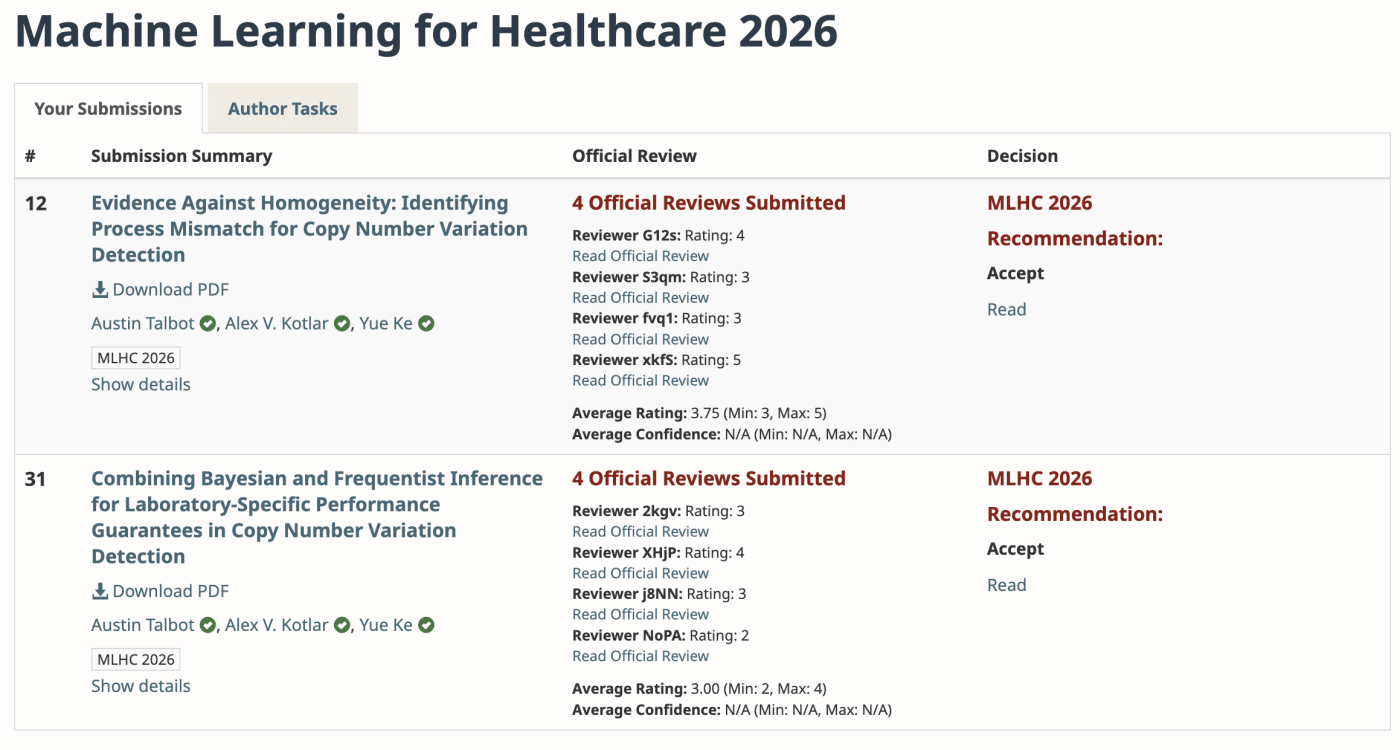
The goal of this post is to demonstrate how Bystro THiNK is able to assist in truly novel research at every stage of the process, from idea drafting to implementation, writing and rebuttals (which will be covered in a separate blog post). The result was “Combining Bayesian and Frequentist Inference for Laboratory-Specific Performance Guarantees in Copy Number Variation Detection”, coauthored with Alex Kotlar and Yue Ke. It was accepted to the research track at the 2026 Machine Learning for Healthcare conference.
At Pillar, we work with targeted amplicon sequencing panels used in oncology diagnostics. These panels can be fast, cost-effective, and compatible with small or degraded samples, but copy number variation detection is statistically difficult. A gene may be covered by only a handful of amplicons. PCR introduces target-specific artifacts. Validation cohorts are often small. Samples produced under a mismatched process can have a different noise profile from the samples used to build the model. Our existing CNV caller is Bayesian. That was useful because a Bayesian model can quantify uncertainty for an individual sample and incorporate prior information. But the validation question a laboratory needs to answer is different:
Across future samples processed by this laboratory, how often will the method make an error of a given size?
That is a repeated-sampling, frequentist question. A posterior credible interval for one sample does not automatically provide a calibrated performance guarantee for a future population—especially when the model is imperfect and each gene has very few observations. That gap became the paper.
Austin's hot take. LLMs currently are unable to conduct focused research autonomously; researchers are in no danger of becoming obsolete. I described the problem where our goal is that as we collect more and more data (implicitly the number of patients) we would have a better idea of what we can detect. Initially, I thought PAC-Bayes might be the way to go. Unfortunately, I did not describe the problem sufficiently, and Bystro assumed I wanted to bound the error as the number of amplicons increased instead (panel design is fixed). It’s a natural mistake to make but doesn’t solve the issue. There’s no substitute for the human in the loop.
Either way, after iterating (see the prompt below), we finally settled on a frequentist-Bayesian hybrid modeling the losses of posterior functionals. It came up with some good ideas, like using a gamma distribution, which is apparently commonly used in finance.
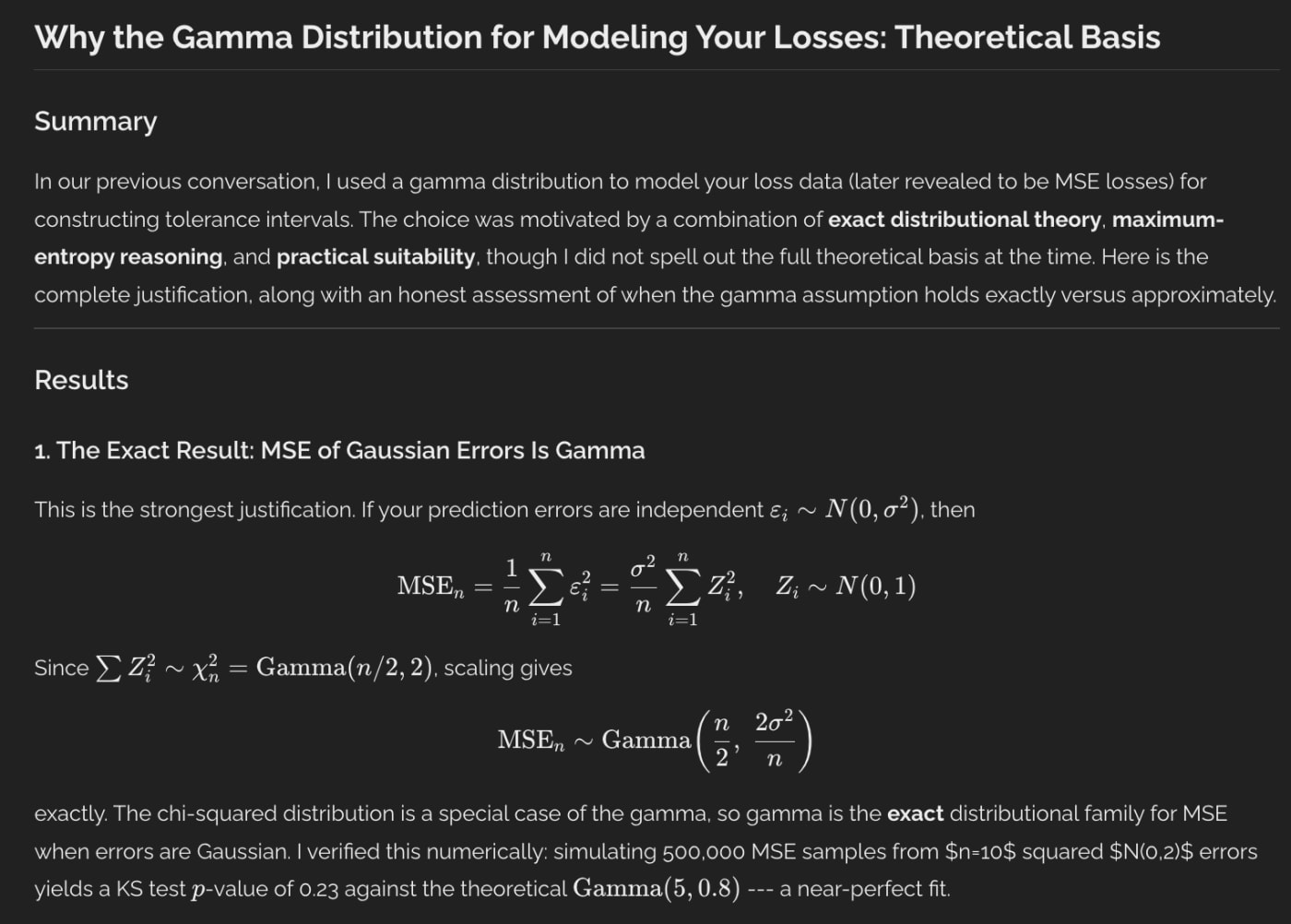
For the purposes of this experiment, I wrote the model using Bystro. I checked that it worked, which it did.
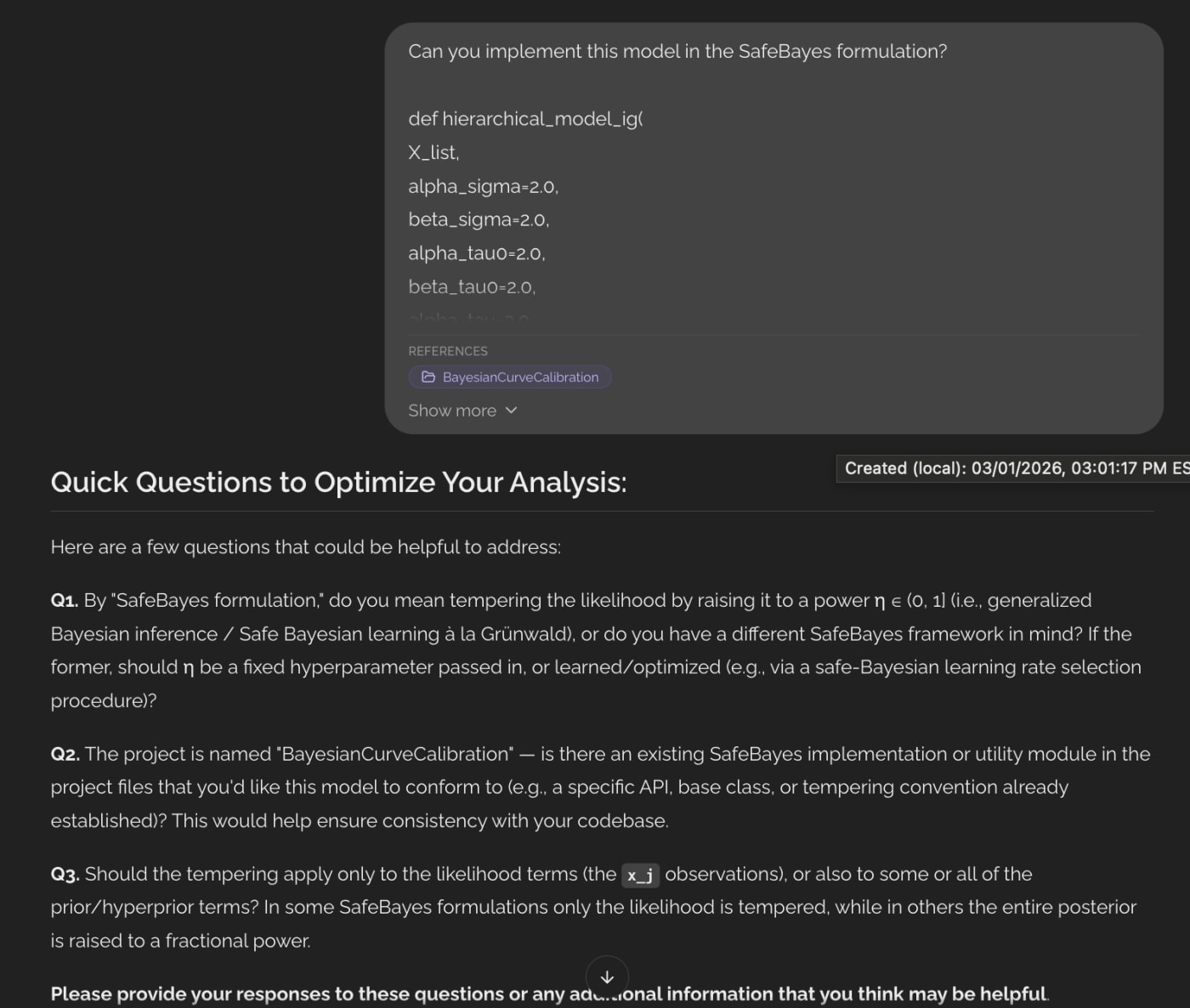
I really hate implementing other peoples’ work. Bystro helped implement and evaluate standard Bayesian highest-posterior-density intervals, a coarsened posterior, a sandwich-adjusted posterior, and a conventional mean-squared-error estimator. It also helped keep the evaluation criterion consistent across methods. I’ll just leave this screenshot here.
It helped organize the argument, draft and revise sections, format equations, summarize results, check whether claims were supported by experiments, and identify places where a reader would need more explanation. I could ask it to make a section more statistically precise, more clinically legible, or more explicit about limitations, then compare the revision against the underlying analysis. Scientific writing still required consequential human choices: what counted as the primary claim, which caveat belonged next to which result, whether a comparison was fair, and whether the evidence supported the strength of the language. Those decisions stayed with the authors.
The result as you can see below was an accepted paper.
See our previous post on how we used Bystro to help write a rebuttal!
