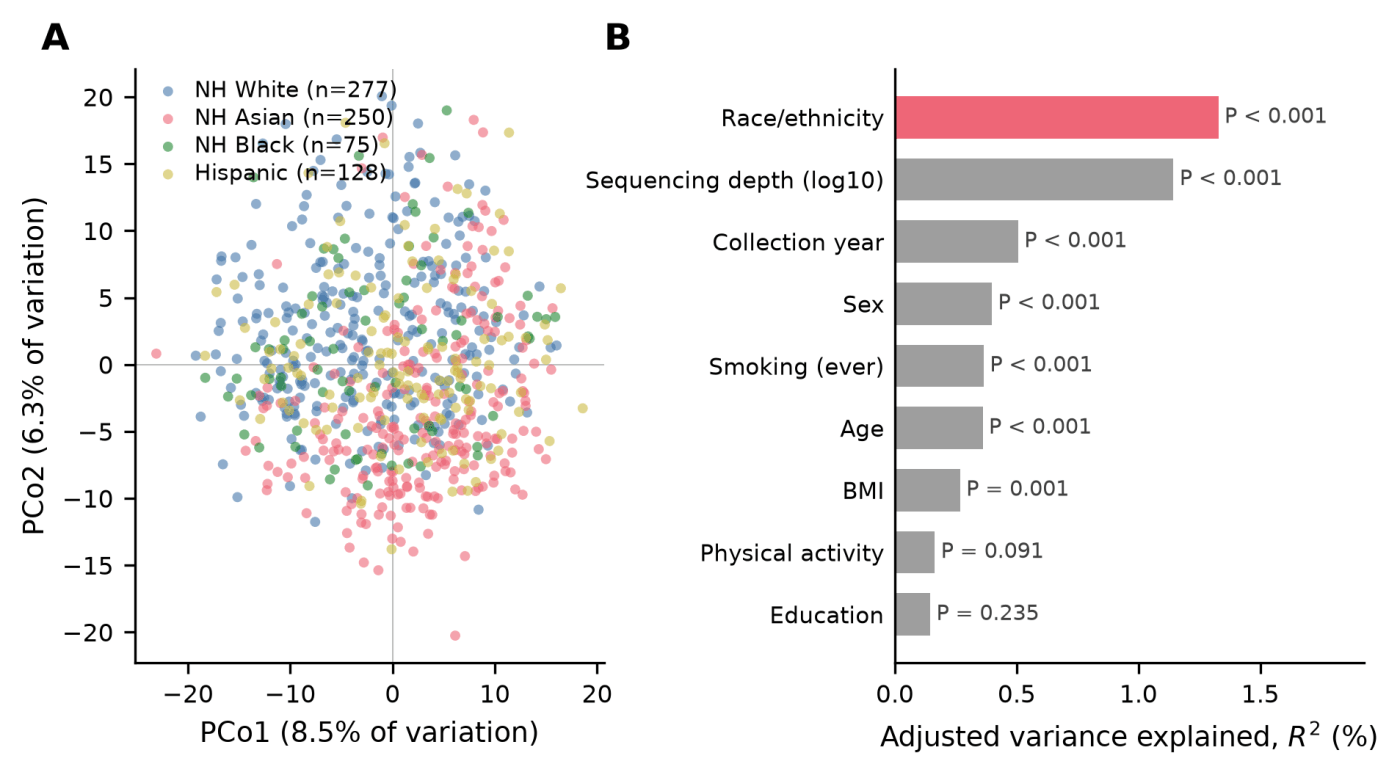
Selected figure from a full research manuscript draft created using bystro THiNK that explores fecal microbiome diversity
Imagine a clinical table in which the same patient identifier appears twice, with slightly different data attached. If the goal is one row per patient, someone has to decide what to do: drop the duplicates, keep the first entry, or something else.
If the agent makes that choice without being asked, it may follow a valid but unintended path, and the work has to be redone. These decisions are best made by the person writing the prompt, which means knowing something about the input data first.
We used the NYU Food and Microbiome Longitudinal Investigation (FAMiLI) study, available through the NCBI Sequence Read Archive (PRJNA559143). We downloaded it with the SRA Toolkit. It includes clinical and fecal microbiome data for 866 individuals and is roughly 4 Gb in size, with about 12 million paired-end 16S rRNA sequencing reads.
The aim was a manuscript ready for submission apart from final formatting. For a problem this complex, it is best to break the work into connected steps within the same conversation. Here are the two we used.
It is tempting to dive straight in. Step back first and ask two questions.
What is the best approach to the problem? Even if we know the field well, we do not have access to the accumulated knowledge of humanity, so some humility goes a long way. It is usually useful to see how others have approached the problem.
What do the input data look like? What is present, what do the summary statistics and quality metrics show, and which fields are relevant?
The output of this step can be checked by a person before anything else is built on it. Two example prompts:
“For the attached SraRunTable.csv file, please create a table describing the clinical data fields that are available and the type of data they hold. Perform a data quality check and flag any poorly populated fields or fields with inconsistent data.”
“Using the SRA_DOWNLOADS.tar.gz archive containing 16S rRNA sequences for each study subject, create a TSV format table of paired read counts for all observed bacterial species by study subject. Also create a table listing the number of different microbial species detected for each patient.”
What you learn here shapes the Step 2 prompt. bystro THiNK will generally ask follow-up questions about any remaining ambiguity, which gives you a second chance to adjust your prompt.
Using what Step 1 revealed, you can now define exactly what the agent should do, so it stays focused on the right problem. Example prompt:
“Please analyze the attached clinical and microbiome data in a statistically rigorous way for associations between microbial populations and clinical covariates (race/ethnicity, age, sex, BMI, education, physical activity, smoking, and stool collection year) to determine what conclusions may be drawn in a statistically rigorous way. Then, write a submission-ready manuscript in the style of the Microbiome journal, complete with figures, figure legends, and references around the statistically significant associations detected. The draft manuscript should be available in the output in Microsoft docx format.”
Following these two steps, bystro THiNK produced a draft manuscript [2] with 3 tables, 6 figures, and 34 references. The work took about 85 minutes in three stages:
5 min 8 sec to analyze the clinical data for 866 subjects by type and field values
29 min 42 sec to quality-check and align about 12 million paired-end reads, and to identify the microbial species in each sample
50 min 28 sec to produce the draft manuscript
Behind the scenes:
The data were uploaded, expanded, and analyzed to determine what was stored where. For example, which columns in the clinical table hold patient demographics, and which hold patient identifiers that match the sequence IDs.
Sequence quality was checked and sequences were aligned to reference sequences. Participants with inadequate coverage were dropped, leaving 730 of the 866 for the primary analysis (non-Hispanic (NH) White n=277, NH Asian n=250, NH Black n=75, Hispanic n=128).
Appropriate statistical tests were identified and implemented, with corrections for multiple testing.
All calculations, data tables, and references were cross-checked for accuracy.
A final report was drafted with conclusions, limitations, and literature references for the studies cited.
The draft is not finished. The tables still need some formatting, and the reference placeholders in the text need to be converted to the journal’s required format.
By separating Survey from Scope, we aimed to keep the agent’s effort on the task that mattered, and we drafted a manuscript from a large, complex data set in about 85 minutes. For researchers still wondering whether agentic AI is ready for serious scientific workflows, this is one more data point worth knowing.
On your next complex analysis, try starting with a Survey prompt, check what comes back, and only then write the Scope prompt.
Read the full manuscript here.